Key Takeaways
- Website measurement should include SEO, conversions, user behaviour, page speed, and business outcomes rather than traffic alone.
- No single platform provides complete insights, making multiple specialised tools essential for accurate reporting.
- Monitoring Core Web Vitals improves both search rankings and visitor experience.
- AI-powered reporting dashboards simplify decision-making by identifying trends and opportunities faster.
- Regular website analysis helps businesses optimise marketing budgets while improving lead quality and return on investment.
Most businesses spend considerable time improving their websites but far less time measuring whether those improvements actually work. Without reliable data, decisions often rely on assumptions rather than evidence.
A proper produce house website analysis examines far more than visitor numbers. It evaluates keyword rankings, page performance, technical SEO, conversion rates, visitor engagement, customer journeys, and marketing effectiveness.
Modern businesses also need to understand how different marketing channels contribute to revenue. Organic search, paid advertising, social media, referral traffic, and email campaigns all play different roles in customer acquisition. Measuring each channel helps prioritise marketing investments.
Businesses working with a professional web design agency Lancaster often benefit from implementing measurement tools during the website planning stage rather than after launch. This creates stronger reporting from day one and supports continuous improvement.
The following ten tools represent some of the most valuable solutions available for comprehensive website measurement.
Why Website Measurement Matters
Many businesses still judge website success by a single metric such as page views or sessions. Unfortunately, those numbers rarely explain whether a website supports business objectives.
Effective measurement answers questions such as:
- Are visitors finding the website through search engines?
- Which pages generate enquiries?
- Why do visitors leave before converting?
- Which keywords attract qualified traffic?
- Are website improvements increasing revenue?
- Is the website delivering a positive user experience?
When these questions are answered consistently, businesses can make confident marketing decisions backed by data instead of guesswork.
What Should a Complete Website Measurement Strategy Include?
A comprehensive website measure process should evaluate multiple performance indicators simultaneously.
These typically include:
- Organic search visibility
- Keyword rankings
- Technical SEO health
- Core Web Vitals
- User behaviour
- Conversion tracking
- Lead quality
- Revenue attribution
- Marketing ROI
- Customer journey analysis
Together, these metrics provide a complete picture of website performance rather than isolated statistics.
10 Website Measurement Tools Every Business Should Use
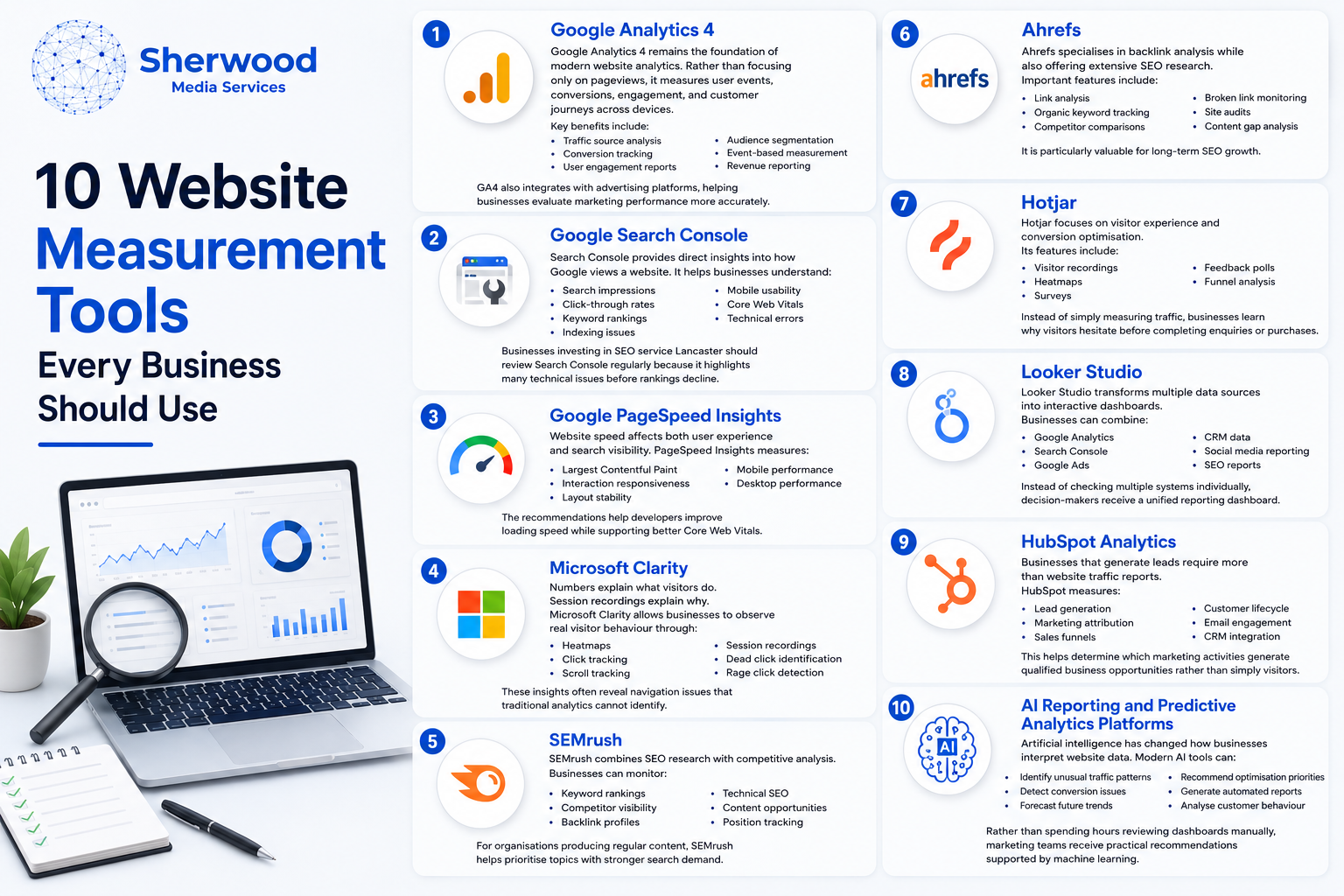
1. Google Analytics 4 (GA4)
Google Analytics 4 (GA4) is one of the most important website measurement tools available today. Unlike older versions of Google Analytics that mainly tracked pageviews, GA4 focuses on user behaviour. It measures how visitors interact with your website, which pages they view, how long they stay, and what actions they take before converting.
Key benefits include:
- Traffic source analysis
- Conversion tracking
- User engagement reports
- Audience segmentation
- Event-based measurement
- Revenue reporting
GA4 also integrates with Google Ads and other marketing platforms, making it easier to evaluate the effectiveness of your digital marketing campaigns.
2. Google Search Console
Google Search Console helps businesses understand how their website performs in Google Search. It provides valuable insights into your site’s visibility and identifies technical issues that could affect rankings.
With Search Console, you can monitor:
- Search impressions
- Click-through rates (CTR)
- Keyword rankings
- Indexing status
- Mobile usability
- Core Web Vitals
- Technical errors
Businesses investing in SEO service Lancaster should review Search Console regularly, as it often identifies problems before they begin impacting search performance.
3. Google PageSpeed Insights
Website speed plays a major role in both user experience and search engine rankings. Google PageSpeed Insights analyses your website’s performance and provides recommendations to improve loading times.
It measures important metrics such as:
- Largest Contentful Paint (LCP)
- Interaction responsiveness
- Cumulative Layout Shift (CLS)
- Mobile performance
- Desktop performance
By following its recommendations, businesses can improve Core Web Vitals, reduce bounce rates, and create a faster browsing experience for visitors.
4. Microsoft Clarity
While analytics tools tell you what users are doing, Microsoft Clarity helps explain why they behave that way. It records real user interactions, making it easier to identify usability issues that may be preventing conversions.
Key features include:
- Heatmaps
- Click tracking
- Scroll tracking
- Session recordings
- Dead click identification
- Rage click detection
These insights help businesses improve website navigation and user experience by showing exactly where visitors encounter difficulties.
5. SEMrush
SEMrush is an all-in-one SEO and digital marketing platform that helps businesses improve their online visibility while monitoring competitors.
It allows you to track:
- Keyword rankings
- Competitor performance
- Backlink profiles
- Technical SEO issues
- Content opportunities
- Position tracking
For businesses publishing regular content, SEMrush makes it easier to identify high-value keywords and topics that have strong search demand.
6. Ahrefs
Ahrefs is widely recognised for its backlink analysis capabilities, but it also offers powerful SEO research tools for improving website performance.
Its main features include:
- Backlink analysis
- Organic keyword tracking
- Competitor comparisons
- Broken link monitoring
- Website audits
- Content gap analysis
Businesses use Ahrefs to strengthen their SEO strategy, build high-quality backlinks, and discover opportunities to outperform competitors.
7. Hotjar
Hotjar focuses on understanding visitor behaviour and improving conversion rates. Rather than simply measuring traffic, it helps businesses understand how users interact with individual pages.
Hotjar provides:
- Visitor recordings
- Heatmaps
- User surveys
- Feedback polls
- Funnel analysis
These insights help identify where visitors become confused or leave the website, allowing businesses to improve page design and increase conversions.
8. Looker Studio
Looker Studio helps businesses turn complex data into easy-to-read visual reports. Instead of checking multiple platforms separately, it combines information into a single interactive dashboard.
It can integrate data from:
- Google Analytics
- Google Search Console
- Google Ads
- CRM systems
- Social media platforms
- SEO reporting tools
This gives business owners and marketing teams a clear overview of website performance, marketing campaigns, and business results in one place.
9. HubSpot Analytics
HubSpot Analytics goes beyond measuring website traffic by connecting marketing performance with sales and customer data. It is particularly useful for businesses focused on lead generation.
It helps measure:
- Lead generation
- Marketing attribution
- Sales funnels
- Customer lifecycle
- Email engagement
- CRM performance
By linking marketing efforts directly to business outcomes, HubSpot helps organisations identify which channels generate qualified leads and revenue.
10. AI Reporting and Predictive Analytics Platforms
Artificial intelligence is transforming website analytics by helping businesses interpret large amounts of data more quickly and accurately. AI-powered reporting tools automatically identify trends, detect issues, and provide recommendations for improvement.
These platforms can:
- Identify unusual traffic patterns
- Detect conversion problems
- Forecast future trends
- Recommend optimisation priorities
- Generate automated reports
- Analyse customer behaviour
Instead of spending hours reviewing multiple reports, businesses receive actionable insights that support faster decision-making and continuous website optimisation.
Comparing the Best Website Measurement Tools
| Tool | Primary Purpose | Best For | Key Strength |
|---|---|---|---|
| Google Analytics 4 | Traffic and conversions | All websites | Complete visitor analytics |
| Google Search Console | SEO monitoring | SEO teams | Search visibility |
| PageSpeed Insights | Performance testing | Developers | Core Web Vitals |
| Microsoft Clarity | User behaviour | UX optimisation | Heatmaps and recordings |
| SEMrush | SEO research | Marketing teams | Keyword tracking |
| Ahrefs | Link analysis | SEO professionals | Backlink monitoring |
| Hotjar | User experience | Conversion optimisation | Visitor insights |
| Looker Studio | Reporting dashboards | Management | Combined reporting |
| HubSpot Analytics | Lead tracking | Sales teams | Revenue attribution |
| AI Analytics Platforms | Predictive insights | Growing businesses | Automated recommendations |
Which Tool Helps You Measure the Success of Your Website?
This question has no single answer because website success depends on business objectives.
For example:
- If SEO growth is the priority, Search Console and SEMrush provide valuable insights.
- If conversion optimisation is the goal, Microsoft Clarity and Hotjar reveal visitor behaviour.
- If reporting across departments is required, Looker Studio creates unified dashboards.
- If lead generation matters most, HubSpot connects website activity directly to sales outcomes.
Using several specialised tools together creates a far more accurate picture than relying on one platform alone.
How to Build an Effective Website Measurement Framework
Businesses should define clear performance indicators before collecting data. A practical website measurement framework includes five key stages.
1. Define Business Goals
Start by setting measurable objectives, such as generating more enquiries, increasing sales, improving search rankings, or boosting customer retention. Clear goals ensure your website data supports meaningful business decisions.
2. Measure Technical Performance
Monitor important technical metrics, including page speed, mobile usability, crawlability, index coverage, website security, and Core Web Vitals. These factors improve both user experience and SEO performance.
3. Track Visitor Behaviour
Analyze how visitors interact with your website by reviewing entry and exit pages, scroll depth, navigation paths, and session recordings. This helps identify user experience issues and conversion barriers.
4. Monitor Conversions
Track valuable actions such as contact form submissions, phone calls, purchases, newsletter sign-ups, and quote requests. Measuring conversions shows whether your website is achieving its business goals.
5. Review ROI Regularly
Review website performance each month by comparing marketing costs, revenue, lead quality, customer acquisition costs, and conversion improvements. This helps connect website performance with overall business results.
Common Website Measurement Mistakes
Many businesses collect large amounts of data without generating useful insights.
Common mistakes include:
- Measuring traffic without tracking conversions
- Ignoring Core Web Vitals
- Reviewing reports too infrequently
- Using only one analytics platform
- Focusing on vanity metrics instead of business outcomes
- Failing to compare historical performance
- Not acting on collected insights
Avoiding these mistakes creates more meaningful reporting and supports continuous improvement.
How Website Measurement Supports Long-Term SEO
Search engines increasingly reward websites that provide excellent user experiences.
Measurement helps improve:
- Search visibility
- Website speed
- Content quality
- Internal linking
- User engagement
- Technical SEO
- Conversion performance
Businesses partnering with a search engine optimization company Lancaster often combine technical SEO improvements with continuous measurement to identify new opportunities as search algorithms evolve.
Conclusion
A successful produce house website analysis involves much more than reviewing visitor numbers. Modern businesses should evaluate SEO performance, Core Web Vitals, visitor behaviour, conversions, lead quality, marketing attribution, and return on investment using multiple specialised tools.
Each platform discussed in this guide contributes different insights, allowing businesses to build a complete picture of website performance and make informed decisions based on reliable data. Consistent website measurement helps identify opportunities, resolve issues early, and improve both user experience and business outcomes over time.
If you would like expert guidance on improving your website’s performance, analytics, or overall digital strategy, Sherwood Media Services can help you understand your data and identify opportunities for continuous improvement. Get in touch with us to learn more about building a website that supports measurable business growth.
FAQs
1. What is a produce house website analysis?
A produce house website analysis is a comprehensive evaluation of a website’s SEO performance, technical health, user behaviour, page speed, conversions, and overall effectiveness. It helps businesses identify strengths, weaknesses, and opportunities for improvement.
2. Which tool helps you measure the success of your website?
No single tool measures every aspect of website success. Google Analytics 4, Google Search Console, Microsoft Clarity, SEMrush, and Looker Studio work together to provide a complete understanding of website performance.
3. Why is website measurement important for SEO?
Website measurement identifies technical issues, monitors keyword rankings, tracks Core Web Vitals, and evaluates user engagement. These insights help businesses make improvements that support stronger search visibility over time.
4. How often should businesses review website performance?
Most businesses should review key website metrics monthly, while high-traffic websites or active marketing campaigns may benefit from weekly monitoring. Regular reviews ensure issues are identified early and optimisation opportunities are not missed.